Learn how to identify aircraft flying overhead using engine count, wing shape, sound, altitude, contrails, and live tracking data.
Start with These 5 Clues
Every aircraft overhead can be narrowed down using five visual clues. Look for them in this order:
1. Number of engines
- Four engines — increasingly rare. If you see four jets, it is almost certainly an Airbus A380, Boeing 747, or Airbus A340. Four propellers usually means a military transport like the C-130 Hercules or A400M.
- Two engines under the wings — the modern standard. Could be almost any airliner from an A320 to a 787.
- Two engines at the tail — regional jets (Embraer E-Jets, Bombardier CRJ) and some business jets.
- No visible engines — look for propellers. Turboprops like the ATR 72 or Dash 8 have propellers but no jet nacelles.
2. Engine position
- Under the wings — virtually all modern commercial jets. Boeing 737, 787, 777; Airbus A320, A330, A350.
- Rear-mounted (tail) — older designs (MD-80, Boeing 717) and many regional jets and business jets.
- On top of the wings — very rare. Mainly specialised aircraft like the Cessna 337 Skymaster or some military designs.
3. Wing shape and winglets
- No winglets, swept wings — older aircraft or some widebodies.
- Tall, upward‑swept winglets (sharklets) — Airbus A320neo family.
- Split winglets (one up, one down) — Boeing 737 MAX.
- Raked wingtips (swept back, no vertical fin) — Boeing 787, 777-300ER.
- Curved, blended winglets — Airbus A350, A330neo.
- Straight or slightly tapered wings — turboprops and older regional aircraft.
4. Fuselage size and shape
- Very wide body (two aisles inside) — widebody. Boeing 777, 787, 767; Airbus A350, A330. These look noticeably thicker from below.
- Slim body — narrowbody. Boeing 737, Airbus A320 families. The vast majority of what you see.
- Double deck — A380 (full length) or 747 (partial upper deck hump). Unmistakable once spotted.
- Small, compact — regional jet or turboprop.
5. Sound and altitude
- High‑pitched whine — modern high‑bypass turbofan (A320neo, 737 MAX, 787, A350). Quieter overall.
- Loud, rasping roar — older turbofan (737-800, A320ceo). The classic jet sound.
- Rhythmic propeller drone — turboprop. Slower, lower, unmistakable.
- Silent until almost overhead, then rumbling — high‑altitude jet at cruise.
If You Only Have 3 Seconds
Quickest possible checklist:
- How many engines? (two or four?)
- Where are the engines? (under wing, rear, or props?)
- What shape are the wingtips? (sharklet, split, raked, or plain?)
- Wide or narrow body?
- Sound — modern quiet whine or older roar?
Guess the type, then check yourself with What Plane. You will learn faster by verifying your guesses than by memorising photo guides.
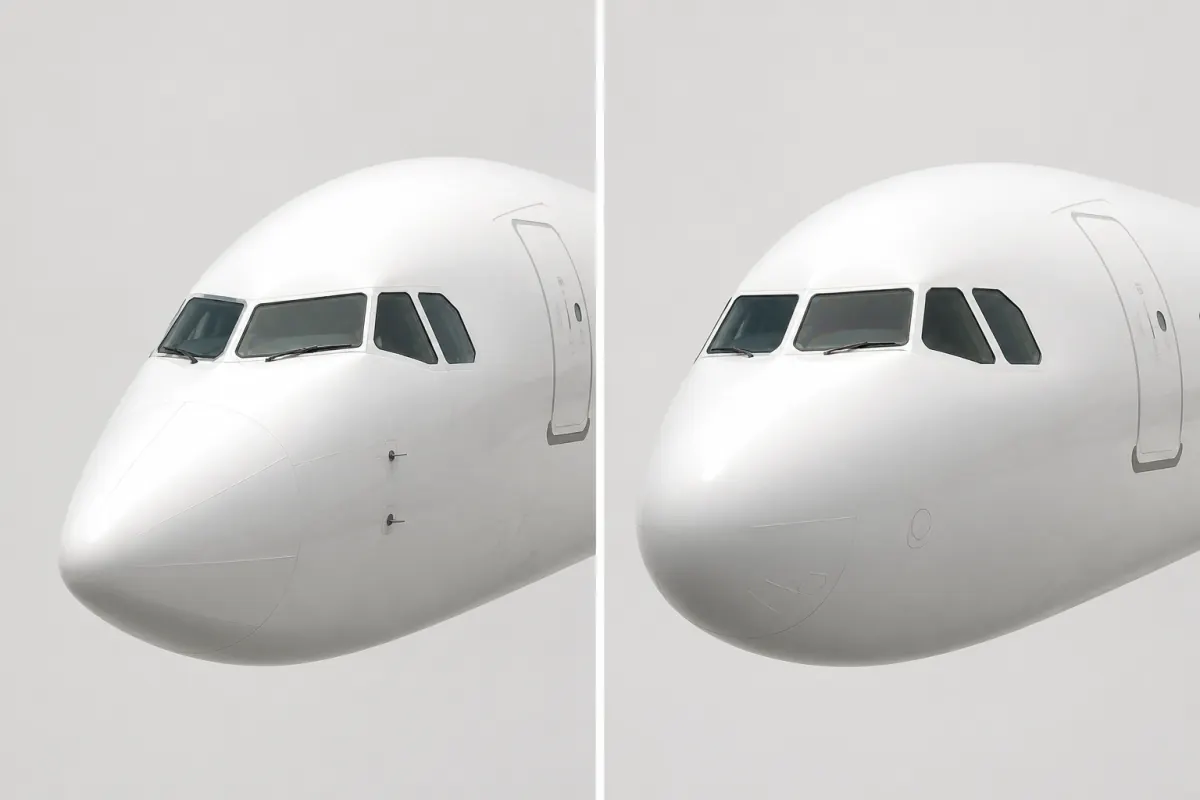
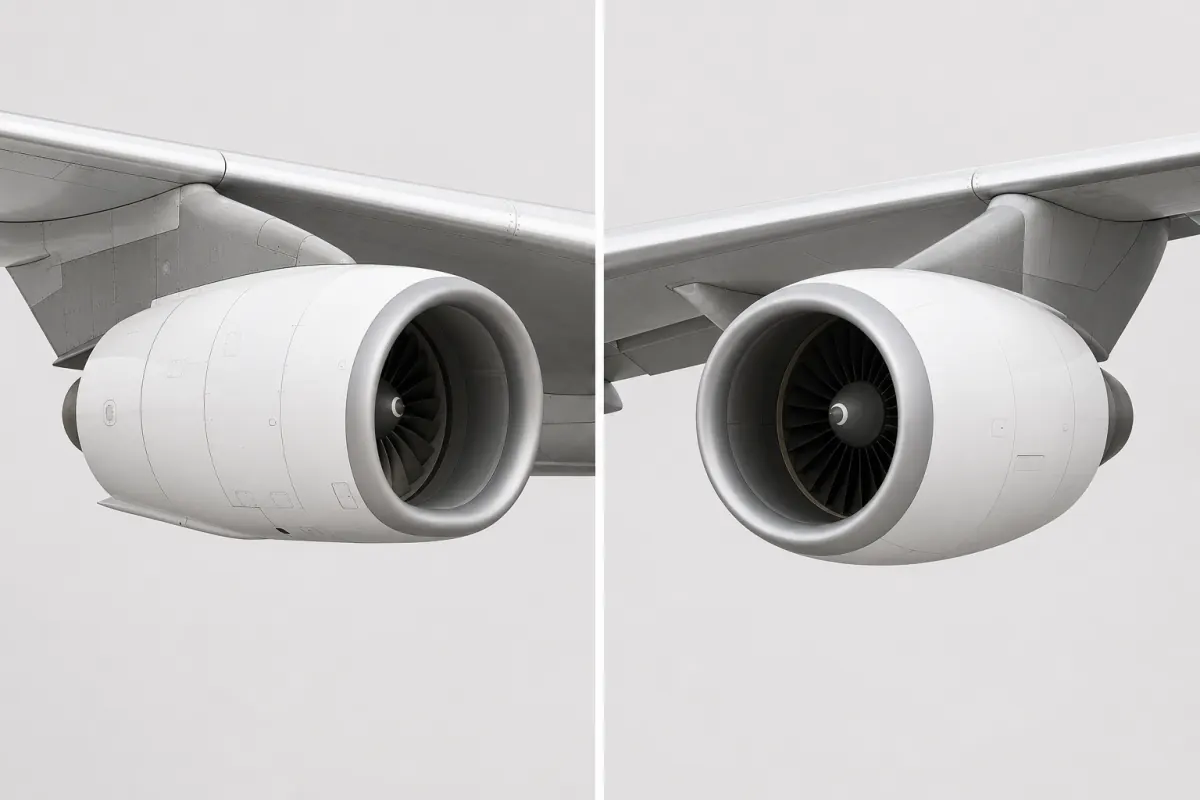
Image Comparison: A320 Family vs 737 Family
These two families account for the majority of commercial flights worldwide, and they look similar at a glance. Here is how to tell them apart:
| Feature | Airbus A320 family | Boeing 737 family |
|---|---|---|
| Nose | Rounder, more bulbous | Sharper, more pointed |
| Cockpit windows | Straighter lower edge | Angled, V‑shaped lower edge |
| Engines | Round nacelles, hang below wing | Flattened bottom, sit forward |
| Winglets | Tall sharklets (A320neo) | Split scimitar (MAX) |
| Stance | Taller, more level | Lower, often nose‑up |
Widebody vs Narrowbody
The difference between a widebody (long‑haul) and a narrowbody (short‑haul) is one of the most useful distinctions you can learn:
| Clue | Narrowbody | Widebody |
|---|---|---|
| Fuselage from below | Slim, like a tube | Broad, noticeably thicker |
| Typical routes | Short to medium haul | Long haul, transatlantic |
| Engines | Smaller nacelles | Large, sometimes enormous |
| Altitude (cruise) | 30,000–38,000 ft | 35,000–42,000 ft |
| Common types | A320, 737, Embraer E-Jet | 777, 787, A350, A330 |
Turboprop vs Jet
| Clue | Turboprop | Jet |
|---|---|---|
| Sound | Rhythmic propeller drone, distinctive throb | Continuous whine or roar |
| Speed | Slower (250–350 mph) | Faster (450–560 mph) |
| Altitude | Lower (15,000–25,000 ft) | Higher (30,000–42,000 ft) |
| Wing position | Often high‑wing | Almost always low‑wing |
| Common types | ATR 72, Dash 8, Cessna Caravan | A320, 737, 787 |
Cargo vs Passenger Aircraft
From below, cargo aircraft can be hard to distinguish from passenger jets. Look for:
- No windows along the fuselage — the most reliable clue for a dedicated freighter.
- Lower fuselage — cargo aircraft often sit lower on the tarmac because they have no passenger cabin floor.
- Freighter types — many cargo planes are converted passenger aircraft (e.g. 737-800BCF, 757-200PCF, 767-300BCF, 777F). They look the same as the passenger version except for the missing windows.
- Dedicated freighters — the Boeing 747 freighter has a distinctive nose‑opening cargo door on some variants. The A300-600ST Beluga has an unmistakable bulbous upper fuselage.
Military Jet vs Commercial Airliner
| Clue | Military fast jet | Commercial airliner |
|---|---|---|
| Speed | Very fast, often supersonic audible | Subsonic, steady speed |
| Altitude | Can be very low (100–500 ft training) | Usually above 2,000 ft over land |
| Sound | Sharp, explosive, very loud | Continuous rumble or whine |
| Contrails | Sometimes single, short duration | Two steady contrails at cruise |
| Formation | Often in pairs or groups | Almost always single aircraft |
| Shape | Small, delta or swept wing, no visible windows | Large tube with visible windows |
See the Military Aircraft Spotting Guide for more detail.
What You Can Tell from Below
When an aircraft is directly overhead, you can reliably see:
- Engine count and position — the most reliable clue at any angle
- Wing shape and winglets — visible even at high altitude through binoculars
- Fuselage width — especially during approach
- Contrail count and spacing — very reliable for engine count at cruise
- Undercarriage — number of wheels and bogie configuration on approach
- Livery colours — if close enough, the airline may be identifiable
What You Cannot Reliably Tell from Below
Some things look like they should be easy to identify but are often misleading:
- Exact model variant — an A320 and A321neo look nearly identical from below; the difference is fuselage length, which is hard to judge from the ground. What Plane will tell you the exact variant.
- Airline from livery alone — many low‑cost carriers look similar, and codeshare flights mean the plane on the tail may not match the operating airline.
- Age of the aircraft — a 25‑year‑old 737 and a brand new 737 MAX share the same basic silhouette. The winglets help, but the model matters.
- Whether it is a freighter — without seeing the windows, it can be impossible. Check the route data.
- Engine type — from below, you cannot tell whether an A320 has CFM56 or IAE V2500 engines. Only the app knows.
Guess the Type, Then Check It
The best way to learn aircraft identification is a simple loop:
- Look up and make a guess: "A320 family, two engines, standard winglets, narrowbody."
- Open What Plane and see the real answer: "Airbus A320-200, easyJet."
- Notice what you missed or got right.
Do this five times and you will already be faster than most casual spotters. Do it fifty times and you will start recognising types before you even reach for your phone.
Related Articles
- Boeing vs Airbus Aircraft Identification Guide
- Every Major Airline and Aircraft Type
- What Plane Is Flying Over Me Right Now?
- Military Aircraft Spotting Guide
Ready to identify planes instantly? Download What Plane? on the App Store →