Learn how to tell Boeing and Airbus aircraft apart using nose shape, cockpit windows, engines, winglets, landing gear, tail shape, and night lights. Most commercial jets come from two manufacturers — this guide shows you how to spot the difference in seconds.
Want to test the clues rather than just read them? Take the free Boeing vs Airbus airplane quiz, or compare the individual Boeing and Airbus aircraft guides.
The Quick Answer
If you only have a few seconds, use this order:
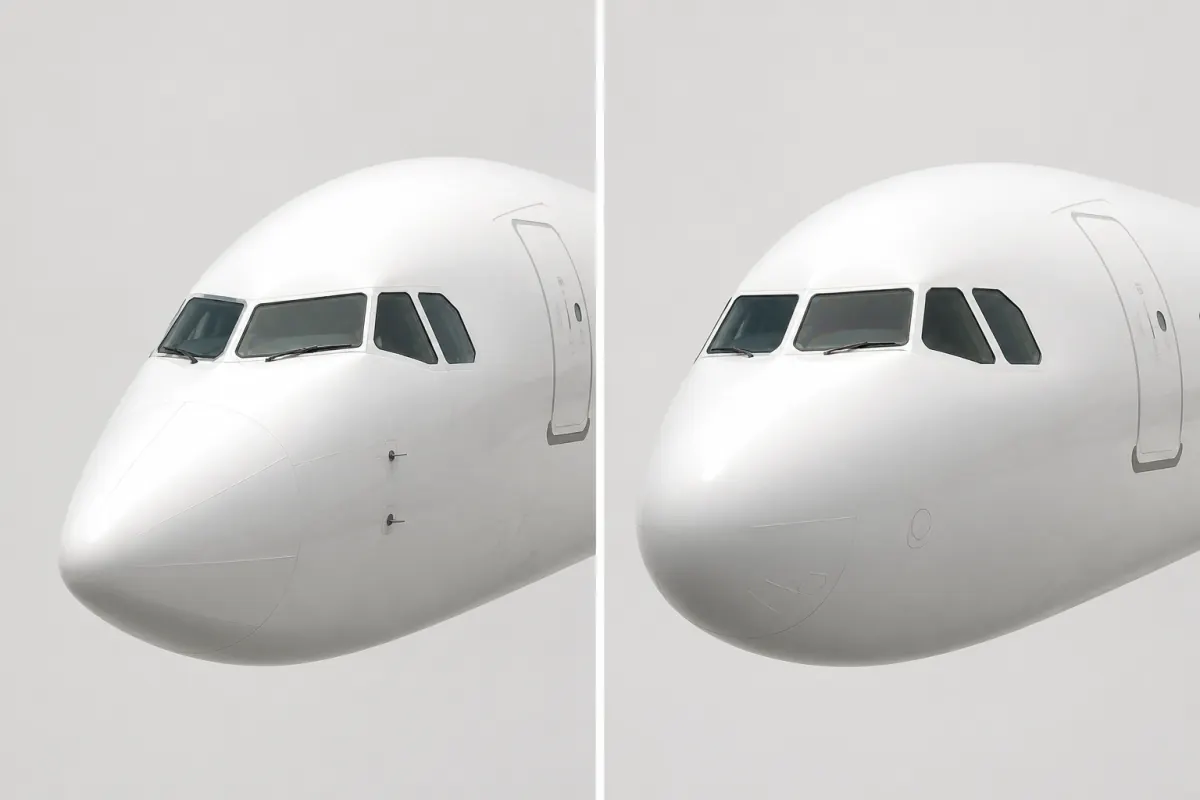
- Look at the nose. Airbus aircraft usually have a rounder, softer nose. Boeing aircraft usually have a sharper, more pointed nose.
- Look at the cockpit windows. Airbus windows tend to have a straighter lower edge. Boeing windows often have a more angular, V‑shaped lower edge.
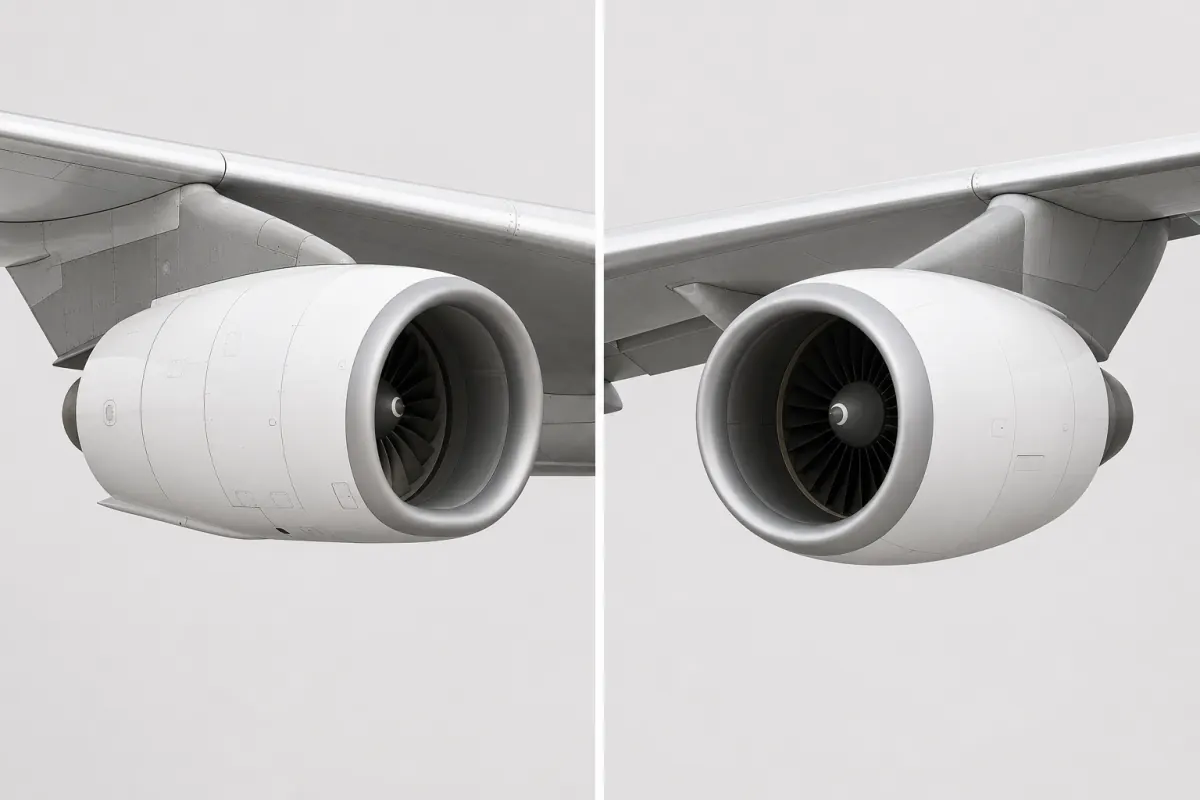
- Look at the engines. A Boeing 737 often has engines with a flattened bottom because the aircraft sits low to the ground. An Airbus A320 usually has rounder nacelles that hang more conventionally below the wing.
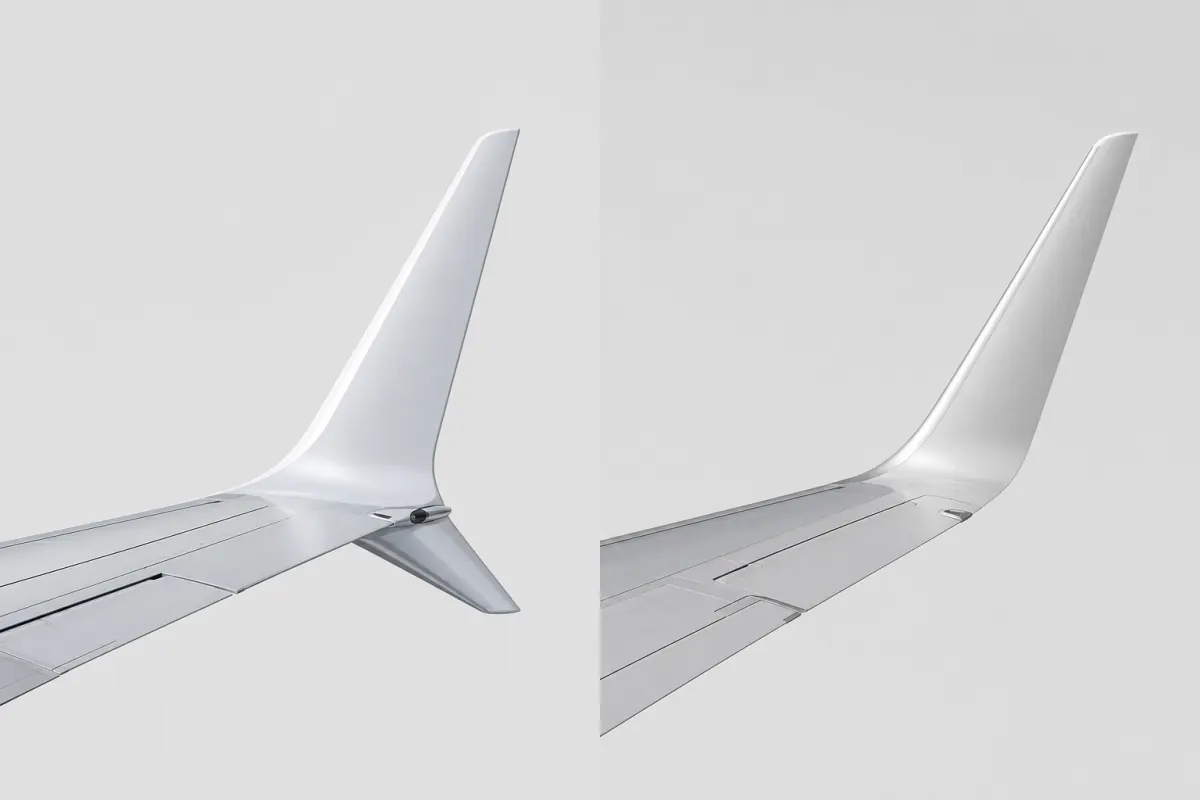
- Look at the winglets. Airbus A320‑family jets often use tall, clean sharklets. Boeing 737 MAX aircraft use split winglets with one fin pointing up and one smaller fin pointing down.
- Look at the stance. The Airbus A320 family sits taller and more level. The Boeing 737 family sits lower, often with a slight nose‑up attitude.
Those five checks will identify many of the aircraft you see at airports or overhead.
Seen one overhead? Open What Plane and confirm the exact model, airline, and route in seconds.
Boeing vs Airbus Identification Cheat Sheet
| Feature | Boeing clues | Airbus clues |
|---|---|---|
| Nose | Sharper, more pointed | Rounder, more bulbous |
| Cockpit windows | Angular, often with a slanted lower edge | Straighter lower edge; notched rear corner on many older families |
| 737 / A320 engines | 737 engines sit forward and often look flat‑bottomed | A320 engines are rounder and hang below the wing |
| Winglets | Split scimitar on 737 MAX; raked tips on 787 and some 777s | Tall sharklets on A320neo; curved tips on A350 and A330neo |
| Ground stance | 737 sits low, often nose‑up | A320 sits higher and more level |
| Landing gear | 777 has huge six‑wheel main bogies; 767 gear tilts forward | A330 gear tilts rearward; A350‑900 has four wheels, A350‑1000 has six |
| Tail and APU area | Often sharper or chisel‑like on widebodies | Often smoother, more conical or rounded |
Nose Shape: The Fastest Visual Clue
The nose is usually the easiest place to start.
Airbus aircraft tend to have a rounded radome that blends smoothly into the fuselage. On an A320, A330, or A350, the forward fuselage often looks softer and more bulbous.
Boeing aircraft tend to have a sharper, more angular nose profile. This is especially obvious on the 737, where the forward fuselage has a more pointed, classic jet‑airliner look.
This clue is not perfect on its own. Aircraft like the Airbus A220 are exceptions because the A220 began life as the Bombardier CSeries before Airbus acquired the program. But for common Airbus A320‑family aircraft versus Boeing 737‑family aircraft, the nose is a strong first clue.
Cockpit Windows: Airbus Straight Lines vs Boeing Angles
Cockpit windows are one of the most reliable manufacturer signatures.
On many Airbus aircraft, especially the A320, A330, and older A340 families, the lower edge of the side cockpit windows forms a straighter line. The rear side window also has a distinctive clipped or notched corner.
On many Boeing aircraft, including the 737, 757, 767, and 777, the cockpit windows look more angular. The lower edge often slopes downward toward the rear, creating a more aggressive V‑shaped look.
Modern widebodies add another clue:
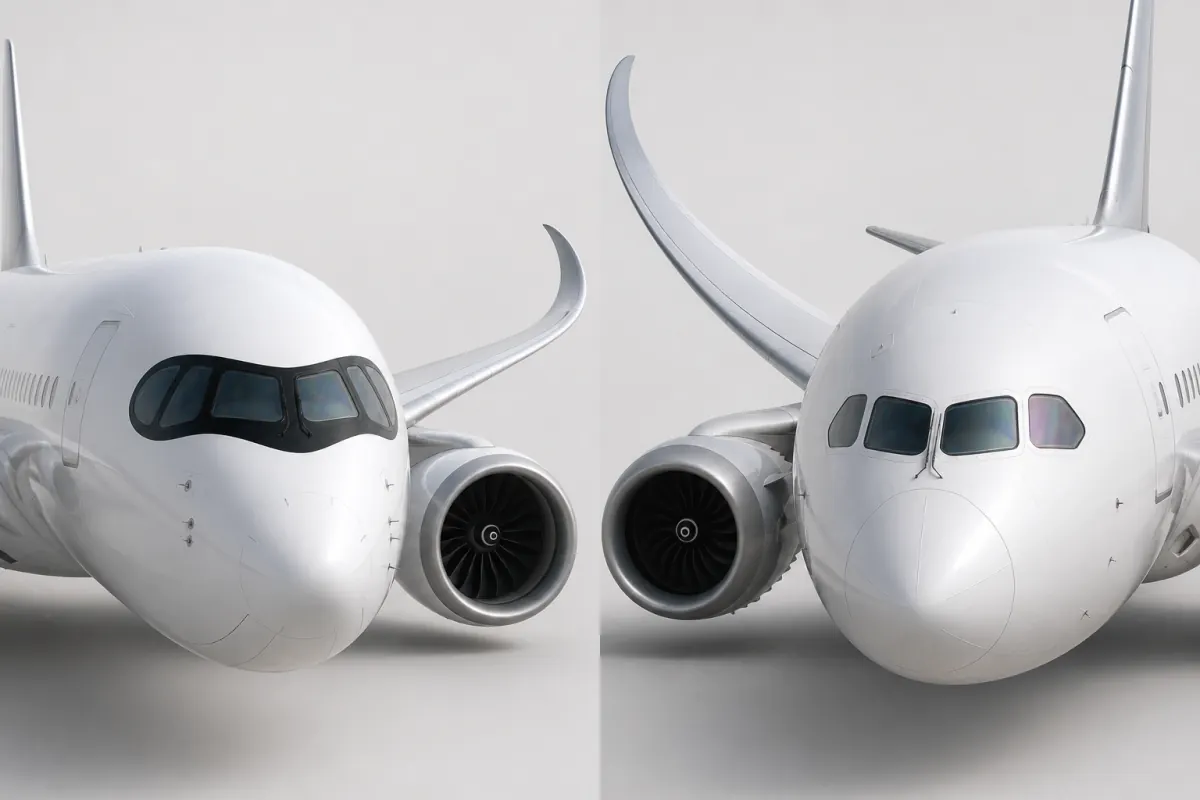
- The Airbus A350 has a black cockpit "mask" around six curved cockpit windows.
- The Boeing 787 Dreamliner has four large cockpit windows and a very smooth, futuristic nose.
If you can see the cockpit clearly, windows are often more reliable than airline livery.
Engines: The Boeing 737 Flat-Bottom Clue
The Boeing 737 is one of the easiest aircraft to identify because of its engines.
The original 737 was designed in the 1960s to sit low to the ground. That made airport handling easier at smaller airports, but it created a problem later: modern high‑bypass engines are much larger than early jet engines.
To fit larger engines under a low‑slung 737 wing, Boeing moved the engines slightly forward and higher. On many 737 variants, especially the 737 NG and 737 MAX, the nacelles look flattened underneath rather than perfectly round.
That flat‑bottomed engine shape is a classic Boeing 737 clue.
By contrast, the Airbus A320 family was designed later, with taller landing gear and more ground clearance. Its engines hang below the wing in a more conventional position and usually look rounder.
So when you see a single‑aisle jet:
- Flat‑bottom engines and low stance: likely Boeing 737.
- Round engines and taller stance: likely Airbus A320 family.
Winglets and Wingtips
Wingtip devices reduce drag by weakening the spiraling vortices that form at the end of each wing. They are also excellent identification clues.
Airbus wingtip clues
The Airbus A320neo family often has tall upward‑sweeping sharklets. They are clean, simple, and vertical compared with the more complex Boeing 737 MAX split winglets.
The Airbus A350 has large, elegant, curved wingtips that blend smoothly into the wing. The A330neo also uses large curved winglets, and older A330s often have smaller canted winglets.
Boeing wingtip clues
The Boeing 737 MAX has split scimitar winglets: one surface points up, and a smaller lower surface points down. This makes the MAX easy to distinguish from many A320‑family aircraft.
The Boeing 787 does not use a traditional vertical winglet. Instead, it has long, raked wingtips and very flexible composite wings that curve upward noticeably in flight.
The 777‑300ER and 777‑200LR also use raked wingtips. The newer 777X adds folding wingtips, which hinge upward on the ground so the aircraft can fit standard airport gates.
Test Yourself: Boeing or Airbus?
Look at a plane overhead. Before you open your phone, run through these three questions:
- Does the nose look round and bulbous, or sharper and pointed?
- Are the wingtips split (one up, one down) or single tall sharklets?
- Does the aircraft sit low to the ground with flat‑bottomed engines, or higher with round engines?
Then open What Plane and check. Every time you guess first and verify second, the clues stick better.
Most Common Mistakes
Mistake 1: Airline livery is not manufacturer
Just because a plane wears British Airways colours does not mean it is a Boeing. BA operates both Boeing 777s/787s and Airbus A350s/A380s. The same applies to virtually every major airline — most operate mixed fleets. Livery tells you the airline, not who built the plane.
Mistake 2: Winglets vary by sub‑variant
Not all A320s have sharklets. Older A320ceo aircraft may have no winglets at all, or small triangular wingtip fences. Similarly, not every 737 has split winglets — the 737 NG has blended winglets that look different from the MAX. Know which sub‑variant you are looking at.
Mistake 3: Nose shape alone is not enough
The A220 (ex‑Bombardier CSeries) has a sharper nose than most Airbuses. Some Boeing widebodies have smoother, more rounded radomes. Nose shape is a strong clue for narrowbodies but should always be used alongside other features.
Landing Gear and Stance
Landing gear tells you a lot about an aircraft's identity.
The Boeing 737 sits low to the ground. The aircraft often appears slightly nose‑up when parked. This low stance is part of why its engines have such a distinctive shape.
The Airbus A320 sits taller and more level. Its engines have more ground clearance, and the aircraft looks less crouched on the ramp.
On larger aircraft, wheel count is useful:
- Boeing 777: six wheels on each main landing gear leg, in a 3‑by‑2 arrangement.
- Airbus A330: usually four wheels per main gear leg.
- Airbus A350‑900: four wheels per main gear leg.
- Airbus A350‑1000: six wheels per main gear leg.
- Boeing 757: four wheels per main gear leg, despite being a narrowbody.
- Airbus A321: usually two wheels per main gear leg.
The tilt of the landing gear can also help. A Boeing 767's main landing gear tilts forward in flight, while an Airbus A330's tilts backward. These details are easier to see during approach or just after takeoff.
Tail Shape and Rear Fuselage Clues
The back of the aircraft is another useful area.
Many Airbus aircraft have a smoother, more rounded or conical tail cone. The A320 family has a recognisable APU exhaust at the rear, and its overall tail shape looks compact and rounded.
Boeing aircraft often have sharper tail‑cone geometry. The Boeing 777, for example, has a distinctive chisel‑shaped rear fuselage. The 787 also has a clean, tapered rear shape and raked wingtips that help confirm the identification.
Tail clues are best used with other features. A tail cone alone may not identify the aircraft, but it can confirm what the nose, windows, and wings already suggest.
How to Tell Boeing and Airbus Apart at Night
At night, the big visual shape clues are harder to see, but lights can still help.
Commercial aircraft use navigation lights, strobes, beacons, landing lights, and taxi lights. The exact pattern varies by model and airline configuration, but some broad clues are useful:
- Airbus aircraft are often associated with a double‑flash white strobe pattern.
- Newer aircraft from both manufacturers can have longer‑duration LED beacon flashes.
- Landing light placement can differ: some Airbus aircraft integrate lights into the wing roots or fuselage, while many Boeing aircraft place lights on the nose gear or under the wings.
Night identification is less reliable than daytime spotting, so combine light patterns with sound, flight path, and the aircraft's silhouette. To get the exact answer, a live aircraft tracker is much faster.
Model-by-Model Comparisons
Boeing 737 vs Airbus A320
This is the most common comparison. The 737 has a sharper nose, angular cockpit windows, lower stance, and engines that often look flattened underneath. The 737 MAX adds split winglets.
The A320 has a rounder nose, straighter cockpit window line, taller stance, and rounder engine nacelles. The A320neo often has tall sharklets.
For a full guide to identification, see How to Identify Aircraft Overhead, then compare the focused Boeing 737-800 quiz and Airbus A320 quiz.
Boeing 757 vs Airbus A321
Both are long narrowbody aircraft, but they look different. The 757 sits tall, has a sharper Boeing nose, and uses larger four‑wheel main landing gear. It looks powerful and slightly overbuilt for a narrowbody.
The A321 is a stretched A320‑family aircraft. It has Airbus cockpit‑window geometry, a rounder nose, and usually a simpler two‑wheel main landing gear setup.
Boeing 767 vs Airbus A330
The 767 has Boeing‑style cockpit windows and, depending on the variant, square tips, winglets, or raked wingtips. Its main landing gear tilts forward.
The A330 has Airbus‑style cockpit windows, a rounder nose, a smoother tail cone, and main landing gear that tilts backward. Older A330s often have smaller canted winglets, while the A330neo has larger curved winglets and a more modern look.
Boeing 777 vs Airbus A350
The 777 is the larger, heavier‑looking aircraft, with huge engines, Boeing cockpit windows, and six‑wheel main landing gear. The 777‑300ER and 777‑200LR have raked wingtips.
The A350 has a black cockpit mask, six curved cockpit windows, elegant curved wingtips, and a quieter, smoother visual profile. The A350‑900 has four‑wheel main gear, while the A350‑1000 has six‑wheel main gear.
Boeing 787 vs Airbus A350
The 787 Dreamliner is known for its four large cockpit windows, very flexible wings, and raked wingtips. Its engine nacelles have visible chevrons on many variants.
The A350 has the black mask, six cockpit windows, larger swept‑up winglets, and no Boeing‑style nacelle chevrons.
Boeing 747 vs Airbus A380
These are the easiest widebodies to recognise. The 747 has a partial upper deck that creates the famous forward hump. The A380 has two full‑length passenger decks, making the entire fuselage look taller and more bulbous from nose to tail.
How to Identify a Plane Flying Overhead
When an aircraft is directly overhead, you may not see the nose or cockpit windows clearly. Use these clues instead:
- Engine count: two engines, four engines, or turboprops?
- Engine position: underwing engines usually indicate modern airliners; rear‑mounted engines point to regional jets, business jets, or older designs.
- Wingtip shape: split scimitar, sharklet, raked tip, or no winglet?
- Contrail count: two contrails usually means two engines; four contrails points to a four‑engine aircraft.
- Landing gear: if it is on approach, wheel count and gear shape can narrow the type quickly.
- Sound: modern Airbus narrowbodies and Boeing 737s can sound different, but sound alone is not reliable.
The fastest method is still a tracker. What Plane? shows the aircraft type, airline, altitude, speed, distance, and direction from your iPhone Home Screen, so you do not have to guess from silhouette alone.
Frequently Asked Questions
Are Airbus planes safer than Boeing planes?
Safety depends on the aircraft model, airline maintenance, crew training, operating environment, and regulatory oversight. Both Airbus and Boeing aircraft operate safely worldwide every day. Identification features do not tell you whether an aircraft is safer.
Is every Boeing aircraft pointed and every Airbus aircraft rounded?
No. It is a useful pattern, not a law. The Airbus A220 is an exception because it was designed by Bombardier. Some Boeing widebodies also have smoother modern noses. Use multiple clues together.
What is the easiest Boeing to identify?
The 747 is the easiest because of its hump. Among common aircraft, the 737 is also easy because of its low stance and flattened engine nacelles.
What is the easiest Airbus to identify?
The A380 is the easiest because it has two full passenger decks. The A350 is also distinctive because of its black cockpit mask and curved winglets.
Can an app tell me the exact aircraft model?
Yes. ADS‑B based aircraft trackers can show the exact type, airline, altitude, speed, and route when the aircraft is broadcasting trackable data. What Plane is designed specifically for the "what is flying over me?" moment.
Related Articles
- How to Identify Aircraft Overhead
- What Plane Is Flying Over Me Right Now?
- Every Major Airline and Aircraft Type
- Best Plane Tracker for Knowing What's Flying Over You
Ready to identify planes instantly? Download What Plane? on the App Store →